The Hub

This project shows the social impact that architecture and architects can have. The Hub serves as the security gate for the Othello tiny-house village for people experiencing homelessness. It was designed and built by high school age girls with the help of local designers as part of an after school program intended to foster equality in the male dominated building trades. The project served a crucial role in Othello Village and provides an aesthetic anchor to the city sanctioned encampment.

Common Ground
 Conceptual architecture can be used to explore ideas that the government is not ready to allow and the market is not yet ready to finance. Common Ground is a conceptual project designed as part of a housing competition by a team of University of Washington Graduate students. The project explores the blurring of the line between live and work, private and common, single and multi-family as it imagines a new form of living that can be fit into a traditional single-family neighborhood.
UW West Campus Utility Plant
 We often take for granted that what is utilitarian is ugly and what is special is beautiful. The West Campus Utility Plant flips that logic on its head by taking a very plain utility plant and turning it into a thing of simple elegance. By wrapping the mechanical systems with screen, the designers turned what could be a very drab wall into what they call the “shadow canvas” where the interplay of light and shadow will provide a dynamic image for the passersby.
The Publix Hotel
 In a city that is often accused of destroying its history, it is nice to see an old building be given new life. In this case, a 1927 single room occupancy building that had sat empty since 2003 was rehabilitated. The building was entirely redone and seismically upgraded while maintaining many of the historic elements that give it character. Tiny original rooms were combined into more modern apartments (often still quite small) and a large addition added over an existing basement. What was once a vacant building is now providing housing and active retail adjacent to the biggest transit hub in the state.
100 Stewart Apartments and Hotel
 Sometimes it is good to be deferential and sometimes it’s good to be bold. The 100 Stewart project attempts to do both simultaneously. Located at a bend in the street grid located near Pike Place Market, it would have a difficult time hiding no matter what it looks like. The project creates a highly transparent lantern of sifting floors. It is bright and dynamic and unmissable. The project then flanks this glowing beacon with two more stoic volumes that seem to be trying to reference the older brick buildings of the neighborhood through the use of regular window openings in a solid field. It is both very modern and yet attempts to pay homage to its surroundings—a very delicate balance.
Seattle Mass Timber Tower
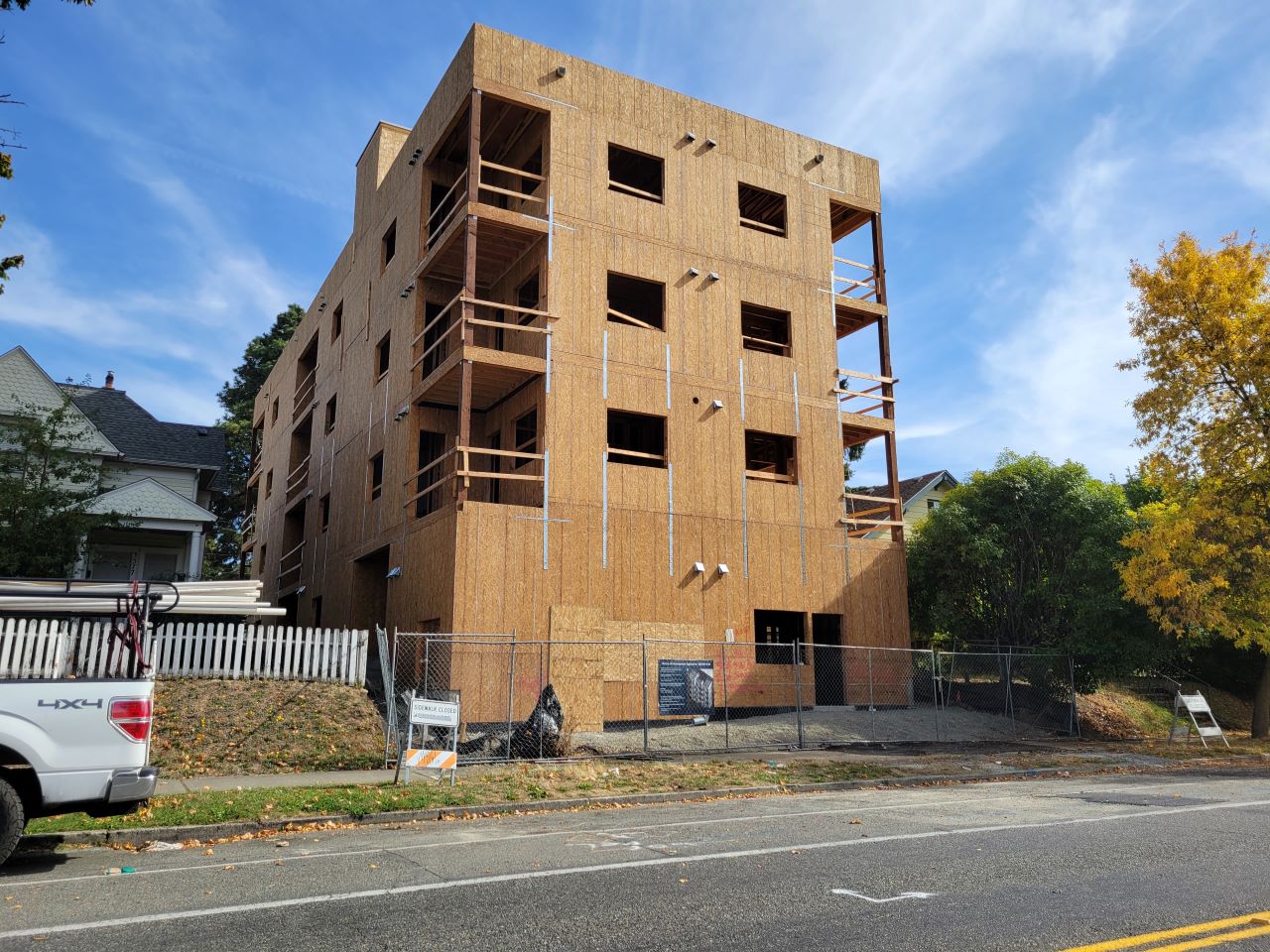
 Seattle is the city with a history of wood—logging, ship building, the craftsman bungalows that dot the city. But wood could also be our future in the form of cross laminated timber (CLT) structural wood panels that allow wood to go much higher that the four or five stories it is used for now. Long used in Europe, CLT construction has the potential to change the building industry. In Vancouver, there is already an 18-story wood dorm building and in Portland they will hopefully soon break ground on 12-story wood building—the tallest in America. The Seattle Mass Timber Tower is a study of what it would take to construct one of the typical new 400-foot towers out of CLT. It is a boundary pushing analysis of hypothetical architecture.
The Right Way
 Lastly, sometimes hypothetical projects can be used to examine ideas that are bigger that what we can allow ourselves to imagine in the world of politics and budgets. The Right Way proposes that instead of filling the Battery Street Tunnel with the ruble of the viaduct as the state transportation department intents, we open it up to the sky and pair ecological restoration with a new vertically multilayered circulation street. Battery Street, along with University Street, are restored into forested creeks, like the ones the settlers of Seattle filled and culverted so many years ago. The new ravines of native plantings serve to cleanse urban runoff, provide auto-free pathways through the heart of the city, and allow for the sights and sounds of nature amongst the tall buildings.
The AIA Seattle Washington Honor Awards will be held November 13th at Benaroya Hall. The entire collection of nominated projects can be seen online. The jurors will be Shirley Blumberg of KPMB Architects, Robert Harris of Lake|Flato, and J. Meejin Yoon of MIT / Höweler + Yoon / MY Studio. The event will be moderated by Vikram Prakash from the University of Washington. Tickets and more information can be found at the Seattle AIA.
All images have been provided by the Seattle AIA.
Lastly, sometimes hypothetical projects can be used to examine ideas that are bigger that what we can allow ourselves to imagine in the world of politics and budgets. The Right Way proposes that instead of filling the Battery Street Tunnel with the ruble of the viaduct as the state transportation department intents, we open it up to the sky and pair ecological restoration with a new vertically multilayered circulation street. Battery Street, along with University Street, are restored into forested creeks, like the ones the settlers of Seattle filled and culverted so many years ago. The new ravines of native plantings serve to cleanse urban runoff, provide auto-free pathways through the heart of the city, and allow for the sights and sounds of nature amongst the tall buildings.
The AIA Seattle Washington Honor Awards will be held November 13th at Benaroya Hall. The entire collection of nominated projects can be seen online. The jurors will be Shirley Blumberg of KPMB Architects, Robert Harris of Lake|Flato, and J. Meejin Yoon of MIT / Höweler + Yoon / MY Studio. The event will be moderated by Vikram Prakash from the University of Washington. Tickets and more information can be found at the Seattle AIA.
All images have been provided by the Seattle AIA.